This report is delivered as a downloadable PDF.
Section 1 — Overview
Forehand (baseline rally)
- Player
- Sample Player
- Level
- Intermediate Club
- Dominant hand
- Right
- Package
- Single Stroke Analysis
- Date
- 9/25/2026
- Order
- SD-SAMPLE01
Reviewed by a Stroke Doctor coach
Overall assessment
You have a genuinely solid technical base — compact preparation, still head, reliable split step. What's holding your forehand back is timing and rotation, not swing shape. Move the contact point forward and let your body turn through the ball, and the same swing will produce noticeably more depth and margin without feeling harder.
Biggest strength
A compact, repeatable preparation — you are rarely rushed on neutral balls.
Biggest immediate opportunity
Spend one session on contact point alone. It is the fix that unlocks the other two, and most players feel the difference within twenty minutes.
Section 2
What you're doing well
- Your split step is consistently timed with the opponent's contact — that's a habit many club players never build.
- Racquet take-back is compact and repeatable, so you rarely arrive late on neutral balls.
- You keep your head still through contact, which is why your clean strikes look genuinely clean.
Technical breakdown — visible elements
Preparation & unit turn
Shoulders close early and consistently. Racquet tip sits slightly low.
Stance & footwork
Neutral-to-semi-open stance chosen well; split step timed with opponent's contact.
Spacing & contact point
Contact tends to sit level with or behind the front hip on most rally balls.
Rotation & weight transfer
Back foot stays anchored, limiting hip rotation and forward weight transfer.
Racket path & follow-through
Low-to-high path is present but the finish stops around chest height.
Balance & recovery
Head stays still through contact; recovery step starts late after the short finish.
Section 3
Top 3 technical priorities
Contact point is drifting behind your front hip
What's happening
On roughly two-thirds of the rally balls in your clip, the ball meets the strings level with or slightly behind your front hip rather than out in front of it.
Why it matters
A late contact point forces your arm to muscle the ball instead of letting body rotation do the work. It's the single biggest reason your depth varies ball to ball.
Exact correction
Start your take-back as the ball crosses the net, not after the bounce. Aim to strike the ball a racquet-length in front of your front foot, with the arm extended but not locked.
Coaching cue
"Catch it early, out in front."
Drill
Drop-feed forehands from the service line, 3 sets of 15. Freeze at contact on every fifth ball and check the ball is visibly ahead of your front hip.
Back foot stays anchored through the swing
What's happening
Your back foot stays planted well past contact, which stalls hip rotation and leaves your chest facing the side fence at finish.
Why it matters
Without hip and torso rotation you lose the easiest source of free racquet head speed, and recovery to the middle is a half-second slower than it should be.
Exact correction
Let the back foot release and swing through naturally after contact, finishing with your chest toward the target and weight on the front leg.
Coaching cue
"Belly button to the target."
Drill
Shadow swings with a deliberate back-foot release, 2 sets of 20, then 2 sets of 10 live balls holding the finish for a full second.
Follow-through is cut short across the body
What's happening
The racquet stops around chest height on the left side instead of finishing over the shoulder, especially on higher balls.
Why it matters
A short finish flattens the swing path, so balls that feel well struck land shallow or clip the net tape under pressure.
Exact correction
Extend through the contact zone and let the racquet finish behind the opposite shoulder. Keep the wrist relaxed so the racquet decelerates naturally.
Coaching cue
"Swing to the catch, finish over the shoulder."
Drill
Rally cross-court for 5 minutes with one rule: every ball must finish with the racquet touching your back. Count the misses out loud.
Section 4
Visual breakdown — annotated stills

Unit turn is good — shoulders are already closed before the bounce.
Watch the racquet tip: it sits slightly low, which adds an unnecessary loop on fast balls.
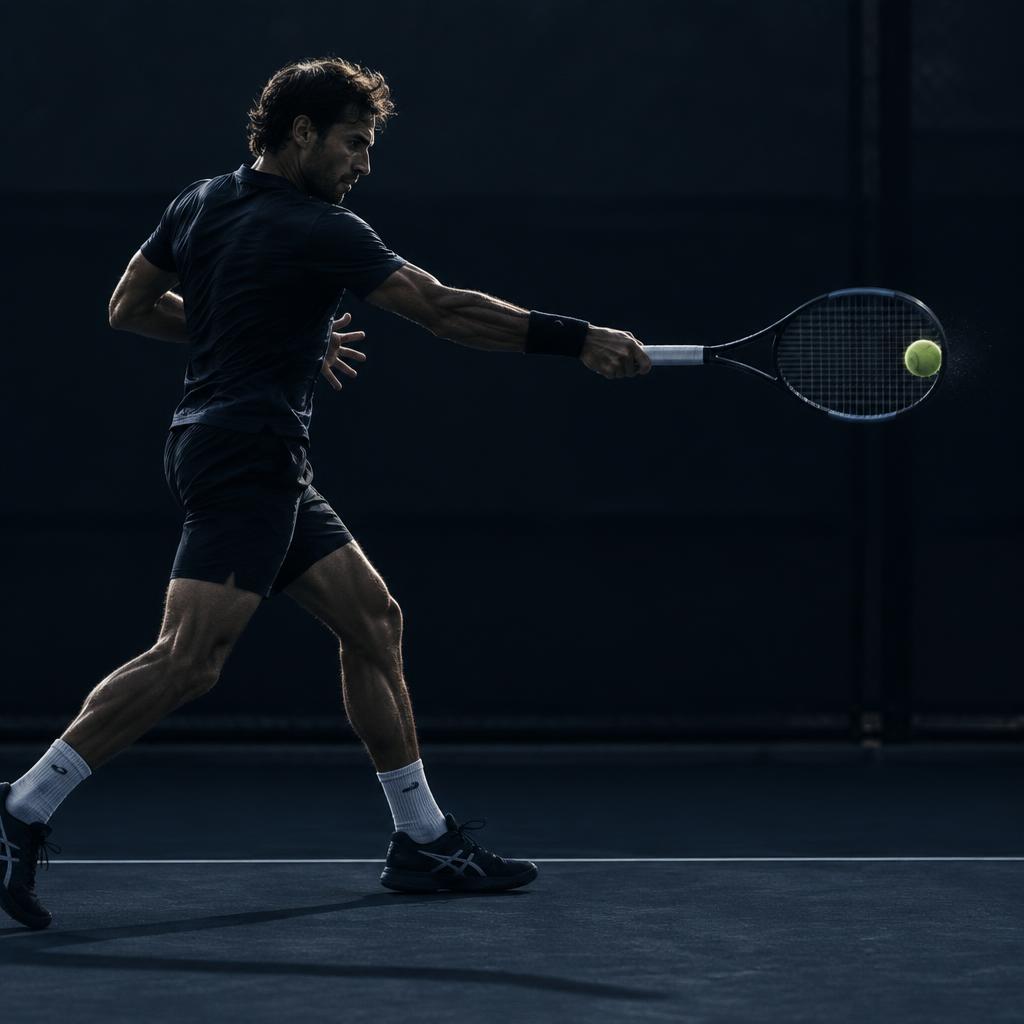
Ball meets the strings level with the front hip rather than in front of it.
This is the frame to fix first. Everything downstream improves when contact moves forward.
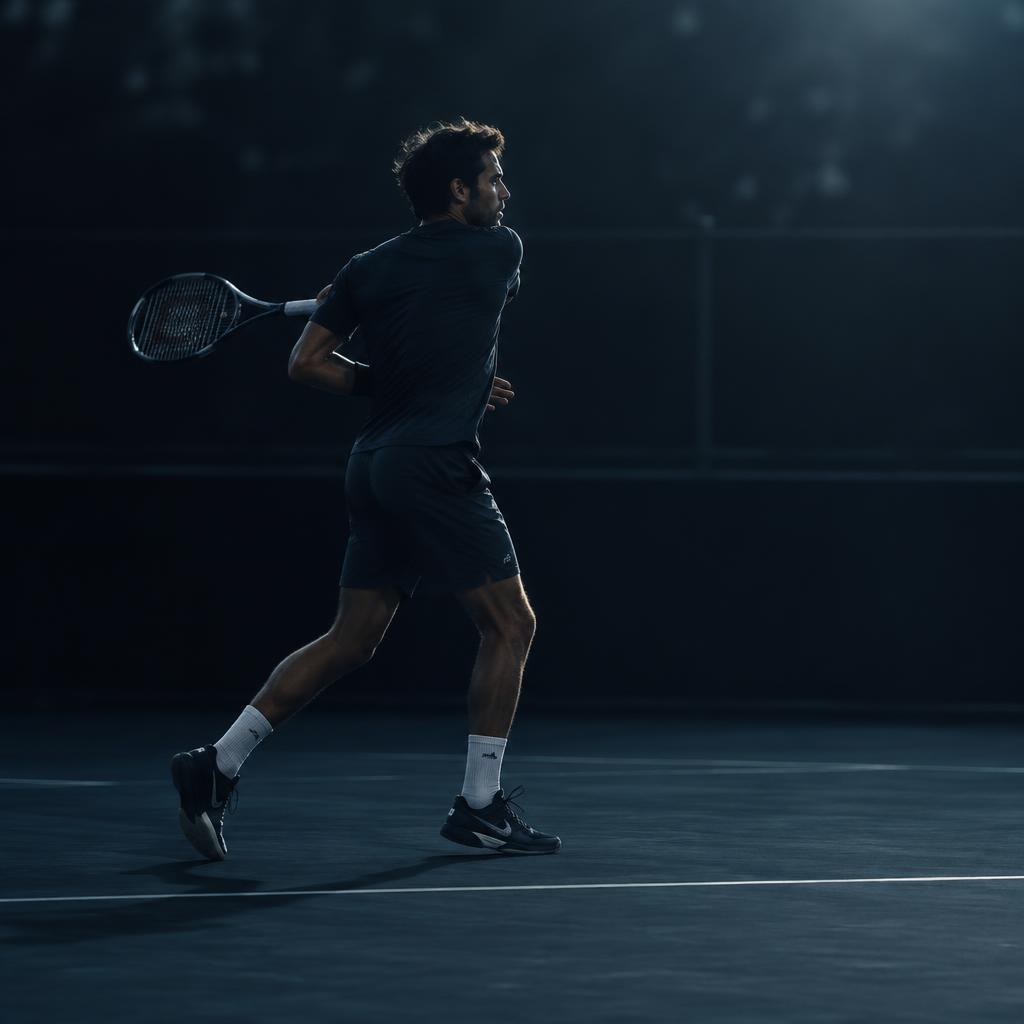
Swing stops at chest height and the back foot never releases.
Recovery step to the middle starts late as a direct result.
Section 5
Your personalized practice plan
Warm-up — mini tennis
Short-court rallies focusing only on early take-back. No pace, no winners.
Block 1 — contact point drop-feeds
3 sets of 15 from the service line. Freeze and check contact ahead of the front hip every fifth ball.
Block 2 — rotation shadow swings + live balls
20 shadow swings with back-foot release, then 2 sets of 10 live balls holding the finish.
Block 3 — cross-court finish rule
Cross-court rally. Every ball must finish with the racquet behind the opposite shoulder.
Cool-down — 10 serve-and-recover
Serve, then one recovery split step. Keeps the footwork habit alive at the end of the session.
Section 6
Your biggest improvements — next-session checklist
- 01
Meet the ball a racquet-length in front of your front foot on every rally ball.
- 02
Let the back foot release so your chest finishes facing the target.
- 03
Finish every groundstroke with the racquet over the opposite shoulder.
Honest limitations: This analysis is based on what is clearly visible in your footage. We do not estimate ball speed, spin rate, joint angles or force unless they can be reliably measured from the video — and in normal phone footage they cannot. Everything above is observable technique, not invented data.